
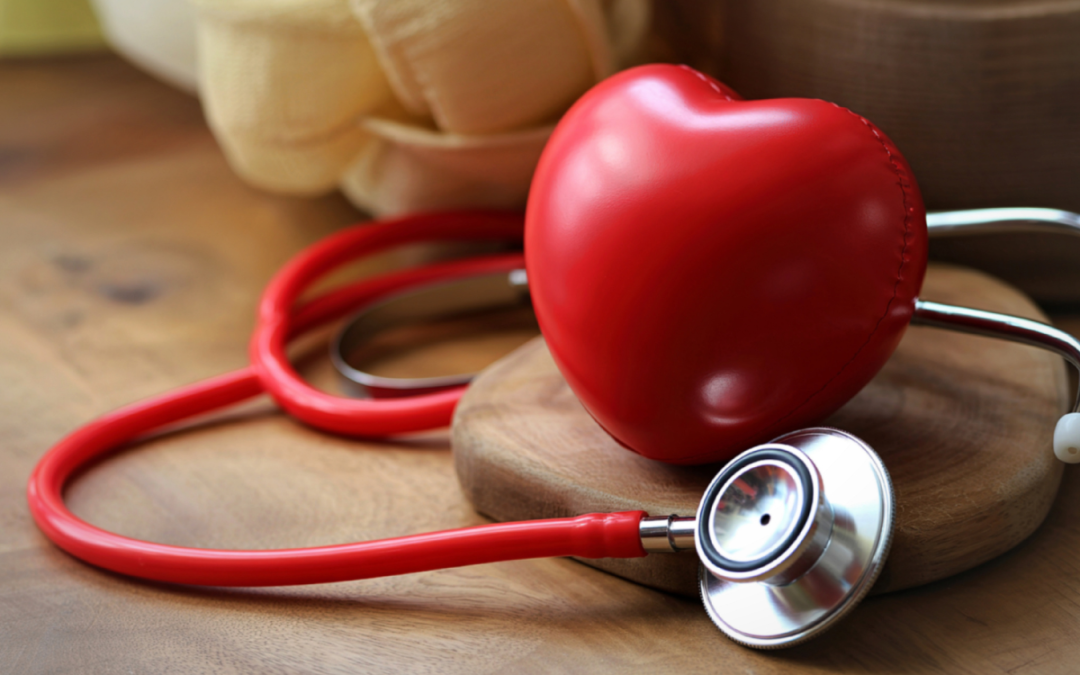
February is Heart Month!
Let’s take a moment to learn about and appreciate your heart. Your heart is about the size of your fist and weighs roughly 10 ounces. It sits just behind and slightly to the left of your breastbone, in the center of your chest. It is protected by your breastbone and rib cage. The heart’s main job is to pump blood throughout your body. It removes the carbon dioxide waste product and picks up oxygen to deliver to the cells. The heart also works with your nervous system to control your heart rate, and your endocrine system to release hormones that tell your blood vessels when to constrict or relax.
The heart’s strong walls squeeze and relax to pump blood through your body. A muscle layer called the septum divides the heart into left and right sides. The heart is also wrapped in a protective sac that makes fluid, which helps prevent it from rubbing against other organs. Your heart has four chambers: two on the top and two on the bottom.
Right atrium: Two large veins, the superior and inferior vena cava, bring oxygen-poor blood to the right atrium. From there, the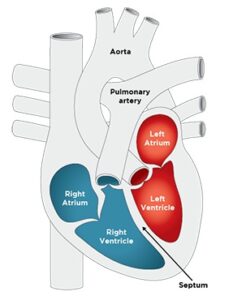 right atrium pumps this blood to the right ventricle.
Right ventricle: This chamber sends oxygen-poor blood to your lungs through the pulmonary artery. In your lungs, carbon dioxide is removed, and the blood picks up fresh oxygen.
Left atrium: This chamber receives oxygen-rich blood from the pulmonary veins and pumps it into the left ventricle.
Left ventricle: This chamber is larger and stronger than the right ventricle. It pumps oxygen-rich blood to the rest of your body.
Heart valves are small flaps that open and close to let blood flow through your heart. They also make sure blood moves in the right direction.
The coronary arteries are the first branches off the aorta, supplying oxygen-rich blood to the heart muscle. Other arteries branch off the aorta to carry oxygen-rich blood to the rest of your body.
The heart has its own electrical system that controls the rhythm and speed of your heartbeats. The signals start at the top of the right atrium and travel down to the bottom of the ventricles.
The Heart Attack
If a coronary arteries become blocked, the heart is deprived of the oxygen-rich blood it needs to function properly. A partial blockage creates a condition known as angina. It is a short-lived pain or discomfort that occurs with increased demand, such as during exercise or extreme stress. This is a warning sign that a heart attack can happen. A heart attack is the death of the heart muscle. How bad it is depends on the location of the blockage and how much heart muscle the artery supplies.
For example:
John left work with bad indigestion. He tried taking antacids, but they didn’t help. Soon, the pain spread down his arm. Alone at home, he worried the ambulance would take too long, so he drove himself to the emergency room. He felt a bit dizzy while driving, and the dizziness got worse as he reached the ER parking lot. He remembers getting out of the car, but nothing after that. The switchboard operator, watching the parking lot camera, saw John pass out and quickly alerted the emergency room staff. The doctor and two nurses rushed out. John was in cardiac arrest, so they started CPR and put him on a stretcher to bring him inside. The heart monitor showed he was in ventricular fibrillation, meaning his heart was quivering instead of pumping blood. They used a defibrillator, but his heart rhythm didn’t change. After giving him epinephrine and using the defibrillator again, his heart finally returned to a normal rhythm. The EKG showed he was having a heart attack. John was stabilized and sent to a larger hospital for advanced care. Doctors found that his main coronary artery, which supplies blood to the left side of his heart, was blocked, so they performed a procedure to restore blood flow.
John was very fortunate that day.
- Many people ignore or deny heart attack symptoms for about two hours before calling 911. Most cardiac arrests happen during this time.
- John managed to reach the hospital before passing out, and the switchboard operator noticed when he collapsed in the parking lot. When the heart doesn’t get enough oxygen, dangerous heart rhythms can happen. If this had happened while he was driving, he could have crashed.
- If John had called 911, the ambulance team would have brought oxygen, medicine, and equipment to lower his risk of cardiac arrest.
Signs and symptoms of a heart attack include:
- Chest pain or discomfort that feels like crushing, squeezing, heaviness, or even bad indigestion.
- Pain in the neck, arm, jaw, or back.
- Shortness of breath.
- Sweating, nausea, or feeling lightheaded.
If you notice any of these symptoms, call 911 right away.
And remember, typically, in men, symptoms of a heart attack include chest pain or discomfort, arm, neck, jaw, or back pain, shortness of breath, sweating, nausea, or lightheadedness.
Women may or may not have these symptoms. They may experience tiredness that won’t go away or feels excessive, anxiety, dizziness, palpitations. Many women attribute these symptoms to less life-threatening conditions such as acid reflux, the flu, or normal aging.
Please share this article with your friends,
and comment below to share any personal experiences



Great Information.
Interestingly, in 2004, I was feeling edgy all day, no pain or chest problems, just Tingly and oof sorts.
My wife demanded we drive to the hospital (25 miles away that evening.
Good thing!
I had a massive Coronary in the ER as I walked in.
Woke up 4 days later from a triple bypass.
Doctor toldme if she had to stop at a couple of stop lights, I would have arrived at the hospital DOA.
Thanks for sharing that…Some symptoms are not dramatically evident.
We all should seek help if we feel ‘different’
Glad you made it Chuck.