
Breast Cancer Screening and Prevention
Sally has a family history of breast cancer. None of her affected relatives were first-degree relatives (mother, sister, father), but she still wants to reduce her risk. She speaks with her healthcare provider to learn about screening, risk factors, and healthy lifestyle choices. This is what she found out.
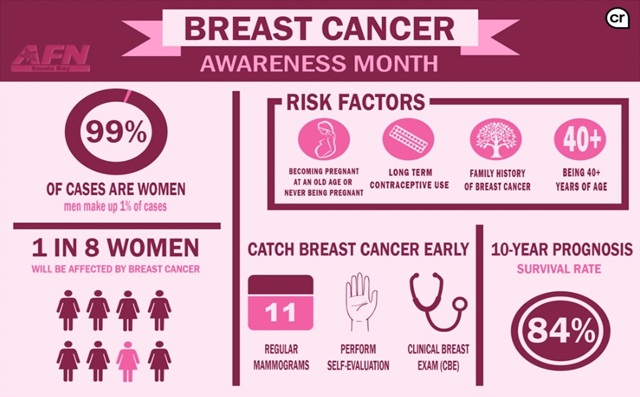
- Breast cancer is the most common cancer among women worldwide, and cases continue to increase. Screening helps detect breast cancer early, when treatment may be more effective.
- The Current guidelines recommend that people aged 40-74 at an average risk have a mammogram every two years. Those over 74 who would choose treatment if diagnosed should discuss continued screening with their healthcare provider. People with a high risk may need annual mammograms beginning at age 30 and annual breast MRI starting between ages 25 and 35. This depends on their individual risk and clinical recommendations. Dense breast tissue can make cancer harder to detect with mammography alone.
- Either 2D mammograms or 3D mammograms are used to detect breast cancer in women. 2 D uses X-rays to take two flat images of each breast (one from top to bottom and one from side to side). All breast tissue is compressed into a single plane. According to the American Cancer Society, sometimes small lesions may be hidden in the breast tissue. 3D mammograms look at tiny slices throughout the breast. This makes it easier to detect abnormalities that 2D mammograms might miss.
- Men can get breast cancer also! Men with inherited BRCA1 or BRCA2 gene mutations or a strong family history have an increased risk of breast cancer. Screening recommendations depend on individual risk. For some high-risk men, screening may begin at age 50 or 10 years before the earliest diagnosis in the family. For example, if John’s father was diagnosed at age 40, John may need to begin screening at age 30, following medical advice.
- Risk Factors for Breast Cancer include
. Increasing age
. BRCA1 or BRCA2 mutations
. Early onset of menstruation
. Late menopause
. Dense breasts
. A personal history of breast cancer or certain noncancerous breast conditions.
. Family history also matters, especially when several relatives are affected.
. Chest radiation before age 30.
. Exposure to the medication diethylstilbestrol (DES), either directly or through a mother’s use during pregnancy. Lifestyle choices influence breast cancer risk. Combined hormone replacement therapy may increase the risk, depending on the treatment and duration. Having a first full-term pregnancy after age 30 or never having a full-term pregnancy and not breastfeeding are also associated with increased risks.These reduce the risk.
1. Participating in moderate physical activity for at least 30 minutes a day, 5 days a week.
2. Maintaining a healthy weight.
3. Eating a diet high in fruits, vegetables, whole grains, legumes, nuts, and seeds. Fiber also helps. Aim for 28-30 grams of fiber a day.
4. Avoiding alcohol consumption.
6. Avoiding smoking
7. Minimizing or avoiding red and processed meats and highly processed foods.
Sally learns that although she cannot change factors such as age or family history, she can take steps to manage her risk. By discussing her personal and family history with her healthcare provider, following recommended lifestyle choices, and following appropriate screening recommendations, she can make informed decisions about her breast health.
Early detection and personalized medical guidance remain essential to prevention and better outcomes.





Very good article.
Thank you, Diane